Surgical elevation of a descended brow — endoscopic, direct, and coronal techniques to restore brow position and reduce forehead lines.
Medically reviewed by EyePlastics Medical Editorial BoardASOPRS oculoplastic surgeonsLast updated June 2026
Part of our complete guide to Upper Facial Aging — this page covers brow lift surgery in depth.
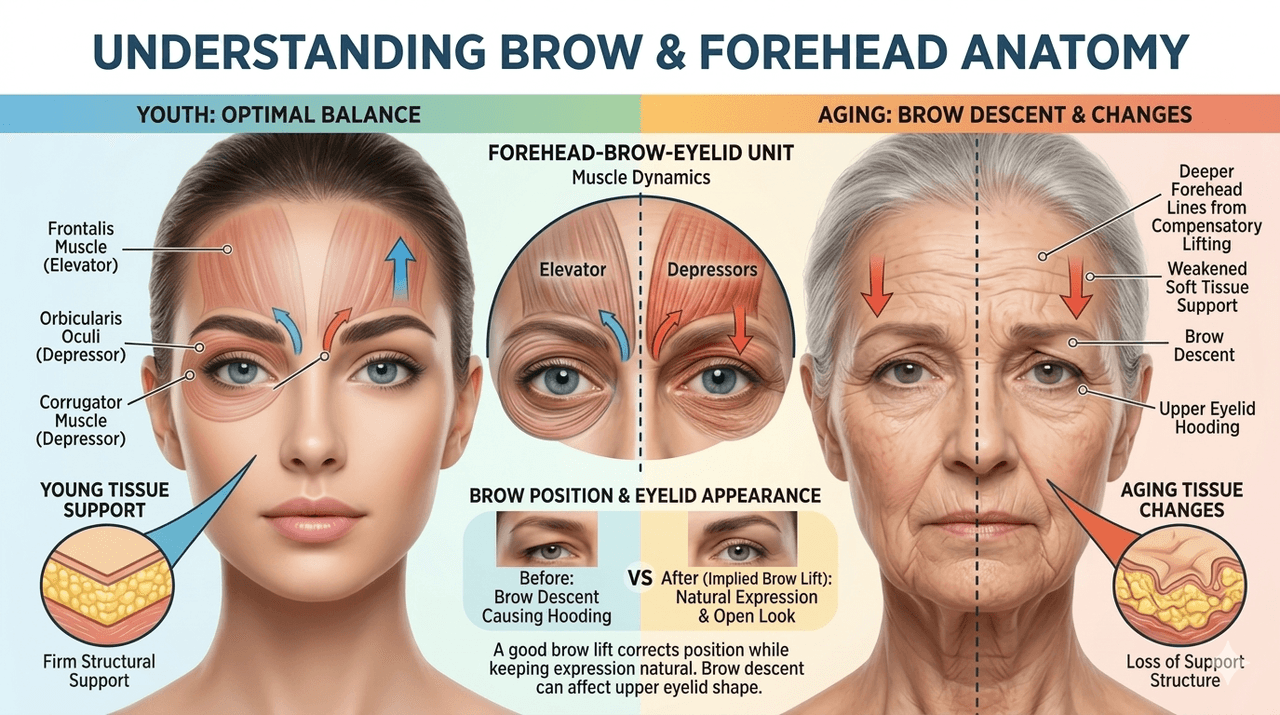
A brow lift (forehead lift) is a surgical procedure to elevate a descended brow to its natural resting position above the orbital rim. As the forehead and brow tissues descend with age, the brows may fall below the supraorbital rim, imparting a tired, heavy, or angry appearance. Brow ptosis can also mimic or worsen upper eyelid skin excess, and it is essential to evaluate brow position before performing upper blepharoplasty.
The brow and upper eyelid are closely related — see Blepharoplasty for details on combined upper eyelid surgery, and Anatomy Overview for the relevant anatomical structures.
The brow complex consists of skin, subcutaneous fat, the frontalis muscle, the galea aponeurotica, and the periosteum of the frontal bone. The frontalis is the only elevator of the brow; the corrugator, procerus, and depressor supercilii are antagonist depressors.
The coronal brow lift uses an incision placed from ear to ear across the top of the scalp, 5–6 cm behind the hairline. It provides the most powerful and predictable elevation of the entire brow and forehead, and allows direct access to the corrugator and procerus muscles to reduce glabellar frown lines.
Procedure at a Glance
The endoscopic brow lift has largely replaced the coronal approach as the preferred technique for patients with a normal or low hairline. Rather than a single ear-to-ear incision, three to five small scalp incisions (1–1.5 cm each) are placed behind the hairline. A rigid endoscope is introduced to provide magnified visualization of the subperiosteal plane — the surgical layer between the periosteum and the underlying frontal bone (some surgeons instead use the subgaleal plane, just superficial to the periosteum) — allowing precise release of the retaining ligaments that tether the brow in a descended position.
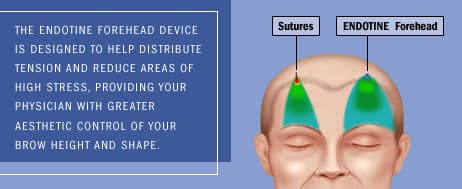
Once the brow is fully mobilized, it is elevated to the desired height and secured using absorbable or permanent fixation devices. Options include resorbable screws, Endotine implants (a multi-tined biodegradable fixator designed specifically for this purpose), or suture-tunnel techniques anchored to cortical bone tunnels centrally or to the deep temporal fascia laterally.
At a Glance
✓ Advantages
— Limitations
The endoscopic approach is the technique of choice at most oculoplastic and facial plastic centers for patients who are good candidates. The incision pattern, fixation method, and degree of elevation are customized to each patient's anatomy and aesthetic goals.
For a complete guide to the endoscopic technique — including candidacy criteria, fixation options, recovery timeline, and before-and-after results — see the dedicated Endoscopic Brow Lift page.
The direct brow lift places the incision directly above the superior eyebrow hairs. It provides precise, powerful elevation of the brow and is particularly effective for patients with significant unilateral brow ptosis or facial nerve palsy where one brow has descended dramatically.
The indirect brow lift places the incision within a prominent forehead skin crease, one to several centimeters above the brow. It is most appropriate for male patients with deep forehead rhytids where the scar can be camouflaged within an existing crease.
Brow and eyelid surgery are frequently performed together to restore the natural relationship between the brow, upper eyelid platform, and lower eyelid. The sequence matters:
The best brow lift technique depends on your anatomy, hairline, degree of ptosis, and goals. An oculoplastic surgeon can evaluate which approach is most appropriate for you. As with any surgery, all brow lift techniques also carry small risks of bleeding (hematoma), infection, and anesthesia-related complications, which your surgeon will review with you before the procedure.
Drag the divider left or right to compare. Select a case in the strip below.

Related Reading
Related in-depth guides
Connect with a board-certified oculoplastic surgeon who specializes in brow lift.
Search the Directory →